
Language: 🇩🇪 | 🇬🇧
Have you chunked today, or are you still chunking away?
It all began when I shared a brief account of my practice session on Instagram and Facebook. In my post, I expressed frustration over my fingers not performing as I wished. To my surprise, a Facebook friend, Patricia George, reached out to me and suggested I try „chunking“ instead of tirelessly repeating passages and exhausting my mental faculties. Although I felt a bit embarrassed admitting that I wasn’t familiar with the method, I immediately turned to Google to learn more about it. Fortunately, just a few minutes later, Patricia sent me a link to her article entirely dedicated to chunking for flute players. You can read it here:
Purchase the book „The Art of Chunking“ by Patricia George and Phyllis Avidan Louke published by presser.com. It is available as a hard copy and digital download.
I was very intrigued. Between 1991 and 1996, during my time in high school, I had learned to practice challenging passages on the flute by playing them slowly. No other intricate or systematic methods were taught to me. However, upon resuming my flute studies at the end of 2021 and enrolling in private lessons, I discovered new techniques. These included approaching difficult passages with various articulations, such as those found in T&G 17 daily exercises, and using dotted rhythms. While I had been taught to break down tough sections into smaller parts, the method outlined in the article was entirely new to me.
Although I don’t have many flute-playing friends, I connected with a wonderful fellow flutist on Instagram who shares my passion for the instrument. To remain anonymous, I will call her „Sabine“ in this blog. Sabine helped me a great deal while I was trying to restart playing the flute again in 2021 and we have kept in touch since through social media. Eager to explore this new approach, I shared the article with her and inquired if she was familiar with the method. While she had encountered variations of it, such as playing a group of notes and holding one before continuing, she hadn’t encountered it in the detailed manner presented in the article. Given our mutual enthusiasm for experimenting with new methods, we decided to embark on this journey together. Over the next 7 days, we pledged to update each other on our progress and even began our conversations with phrases like „Hey, have you chunked today?“ or „What are you currently chunking?“
Now, I’d like to share my experience of chunking over the course of 7 days. I „chunked“ the following material:
- Andersen Op. 33, Etude #4
- Karg-Elert, Sonata Appassionata
Day 1 | Practicing how to „chunk“
I am practicing chunking for the first time (1234, rest/breathe…. 1234, rest/breathe). It feels so unusual but I think I understand the concept. Remember: The most important part of this concept is the tiny rest after playing the chunk and taking a sip of air. It is in this moment where the magic happens.
Day 2 | Concentrating on the details
By focusing on small, manageable chunks, my mind remains uncluttered, allowing me to avoid feeling overwhelmed. Rather than opting for the easier path of merely playing the notes, I’m actively addressing any weaknesses in my performance, honing my skills with precision and care.
Finger Position: My right hand fingers are consistently positioned too high and are often off the keys, resulting in an uneven technique and increased likelihood of mistakes. This leads to sloppy finger movements. I am working on keeping my fingers close to the keys.
Tone: While my tone generally meets standards, I remain attentive to its quality and aim for continual improvement.
Dynamics: Focused on refining the quality of tone particularly at soft (p) and very soft (pp) dynamics.
Intonation: Constantly striving for precise intonation.
Body Tension: I frequently experience tension, especially during challenging and lengthy passages. I am actively working on relieving this tension by exhaling deeply after each segment. I am thinking to myself: „easy light fingers, no matter how tricky the passages are.“ Since the passages are short chunks, it is easier to achieve this. In the moment of release, I make a conscious effort to let go of all tension before continuing“. However: this is easier said than done. The topic of playing with tension will have to be a whole new subject.
Reading the musical theory: I often struggle to discern individual notes, especially amidst dense clusters of black notes. I prioritize key notes, but recognize the need for a more comprehensive approach. Although, my music theory is very limited, I now take the time to try to understand the musical fundamentals while chunking. For particularly challenging passages, I try to identify elements like dominant/diminished 7th chords, sequences, and intervals to enhance my understanding and performance. Even understanding that a passage is in „D minor“ and the next passage ist in „F-Major“ helps me to learn the music better. Thomas Bauer is a fantastic teacher who always emphasizes this. In the past, I have had a bit of trouble reading the music theory but by chunking, I am able to put his advice more to practice.
While chunking, I sent an instagram message to Sabine, who was also chunking away. It sounded like she was having fun and after exchanging our experiences and a few other emojis, I felt confident that I was on the right path. I chunked for a while after that and then called it a day.
Day 3 | Trusting the process
I am still feeling relentless and impatient. Breaking down phrases instead of playing them as a whole feels strange. I’m questioning whether this method will really work and feel the urge to practice longer phrases at a slower speed just to get the feeling that I am making some kind of progress.
The challenge lies in taking a sip of air (as the article describes) after each chunk. I am so impatient and tempted to skip the sip of air altogether. This is still very unusual.
To stay motivated, I have a digital metaphor in my head. I envision that data gets saved on a hard drive (which represents my brain/body) while taking a sip of air, and this reminds me to trust the process.
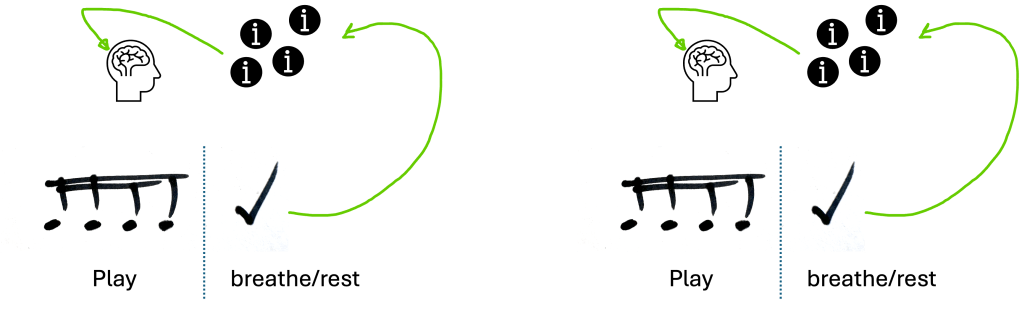
Practice notes:
- I realize that I am clipping the last note of each group – Sabine warned me about this and she was right! I need to make sure to treat each note equal despite the chunking.
- It’s not so easy to connect with the music because of isolating chunks.
- Mindful practice: It is easy to switch off the brain and just play notes. If this is happening, stop and pay attention to the details and weaknesses outline in Day 2.
Day 4 | First Quick Wins
I cheated by putting together some parts of the music. (I had set a goal of chunking for a week before putting things together). At the beginning of my practice, I noticed that I was actually nailing the tricky passages! This is exciting! I’m still not there yet though, so I am sticking to the chunking according to the article (1234, rest/breathe…..1234, rest/breath)
Day 5 | A short fallback due to impatience
After experiencing success the previous day, I regrettably reverted to bad habits, attempting to play everything together, hastily and without pausing. Despite my excitement over mastering challenging passages quickly, I was overly optimistic in assuming I had perfected them. Reality swiftly intervened, as my fingers faltered, reminding me that chunking was necessary for systematic processing. However, after several chunking sessions, I regained the proficiency I had reached by the end of day four, which reassured me. The lesson learned: success is not achieved hastily.
Day 6 | Adding a bit of variation to counteract the feeling of monotonous practice
I decided to add a bit of spice to things while sticking to the chunking method. On particularly difficult parts, I used different articulations. I have also learned to use different rhythms, but I decided not to do that this time because according to the article, pupils are supposed to play the chunks at the original tempo without rhythmic variations.
Day 7 | The results are in
I’ll be candid. When I began this endeavor and read the article, I harboured great optimism, envisioning it as THE method for me to achieve flawless performance in just 7 days. Yet, deep down, I recognized the fallacy of this expectation, as the article made no such promise. It was merely one of my own hopeful musings, as I often conceive.
Today, I finally merged some of the etude’s and the piece’s chunks to assess the final outcome.
The once particularly challenging sections of the Etude (Andersen Op. 33, Number 4) and the piece (Appassionata by Karg-Elert) now flow more smoothly under my fingers. Although I’ve worked on the Karg-Elert for some time, a few passages always eluded complete mastery. Yet, after 7 days of chunking, I feel a significant leap forward (a much bigger leap in 7 days compared to the leap in the past months).
Did I meet my lofty goal of mastering both pieces? Certainly not. There are still passages that trip me up, requiring further chunking or alternative methods from my repertoire.
Nevertheless, among the methods I’ve learned, this one stands out as exceptionally effective. In the past week, I’ve gained valuable insights into how the brain processes information—a thrilling discovery in itself. I wonder why I wasn’t introduced to this technique long ago and am genuinely grateful to Patricia George who introduced this to me. While I know that this is only one of many methods one should apply to a practice routine, I will definitely be exploring more of this method in my daily practice. Next, I want to explore the Kincaid chunking variation (1 rest 2341) according to the article.
Have you heard of this method before? If not, start chunking! And if yes, what are you chunking at the moment?
Happy practicing and chunking!
 Flutehacks Deutschland | Querflöte: Alles auf einen Klick
Hinterlasse einen Kommentar